🦉 Owl
Type: Theriotype (real, earthly animal)
By the Inner Therian team · Last updated October 10, 2026
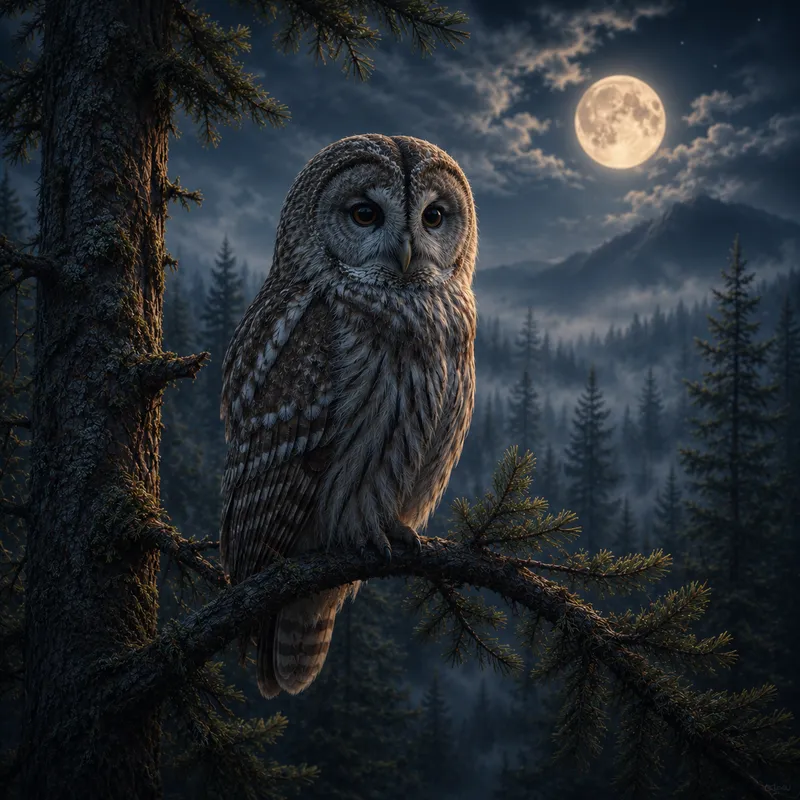
Owl therians are quiet, observant, and most awake at night. As nocturnal hunters, owls embody stillness and sharp perception — and owl therians often describe introspection, comfort in the dark, and a thoughtful, watchful nature.
Owl therians frequently feel most themselves in the quiet hours, drawn to solitude, reflection, and careful observation before acting. There's often a calm wisdom and a sensitivity to sound and subtle detail.
How Owls Actually Work
There are roughly 250 species of owl, from the sparrow-sized elf owl of the American Southwest to large eagle-owls that can take prey as big as a fox. They live on every continent except Antarctica. Despite those differences, they share a set of features that make them unlike any other bird.
- Hearing first. The round facial disc works like a satellite dish, directing sound toward the ears. In barn owls and several other species, one ear opening sits higher than the other, so the owl can tell whether a sound is coming from above or below as well as left or right. Barn owls can catch prey in complete darkness using sound alone.
- Fixed eyes, flexible neck. An owl's eyes are tube-shaped and can't move in their sockets, so the whole head turns instead. Owls can rotate their heads about 270 degrees, helped by having twice as many neck vertebrae as humans and special blood vessels that keep blood flowing while the neck twists.
- Silent flight. Comb-like edges on the leading flight feathers, soft fringes on the trailing edges, and a velvety feather surface muffle the sound of air moving over the wings. Prey often don't hear an owl coming.
- Pellets. Owls usually swallow small prey whole and later cough up the bones and fur they can't digest as a compact pellet.
Not Every Owl Is Nocturnal
Owls are famous for being night birds, but that isn't always true. Many species are most active at dawn and dusk. Snowy owls hunt in the round-the-clock daylight of the Arctic summer. Burrowing owls live in underground burrows on open grasslands and are often seen standing outside them during the day.
This is worth knowing if you're questioning. An owl therian isn't required to be a night owl, and a person who simply likes staying up late isn't automatically an owl. What usually matters more is the quality of the connection: stillness, listening, waiting, and a feeling of belonging in quiet, dim places.
The Owl Therian Headspace
Many owl therians describe a predator headspace that is very different from a hawk's. Instead of scanning a bright horizon, it's about sitting perfectly still and letting sound come in. Common experiences people describe include:
- Sensory shifts where hearing seems to sharpen and small sounds like a rustle or a click grab their full attention.
- A phantom sense of the head wanting to turn much further than a human neck can. (Please don't force it. Human necks don't have those extra vertebrae.)
- Phantom wings that feel broad, soft and wrapped close around the body when resting.
- Feeling overwhelmed in loud, bright places, and calmer in dim light.
- Watching for a long time before speaking or acting, which others sometimes mistake for shyness.
Nocturnal habits can be lovely, but human bodies still need regular sleep. If being an owl therian draws you to the night, try to protect your rest. A dim, quiet evening routine can satisfy that pull without wrecking your sleep schedule.
Owl or Another Night Animal?
Owls share a lot of their atmosphere with other theriotypes. A few ways to compare:
- Owl vs. raven. Both get linked with mystery and wisdom in folklore, but ravens are noisy, social, playful songbirds that are active by day. Owls are mostly quiet, solitary hunters. If your bird-sense involves lots of chatter and mischief, think about the corvids.
- Owl vs. panther. Both are stealthy night hunters. The big difference is the body: do your phantom shifts involve wings and talons, or paws, a tail and a crouch?
- Owl vs. hawk. Hawks hunt mainly by sight in daylight, while owls rely heavily on sound. Ask yourself which sense you lean on during shifts.
The "Wise Owl" Myth
The idea that owls are wise is very old. In ancient Greece the little owl was linked with Athena, goddess of wisdom. Scientifically, though, owls aren't unusually good at problem-solving compared with birds like crows or parrots. Their brains are heavily devoted to processing sight and sound for hunting.
That matters because some people assume an owl theriotype is a sign of being smart or "old-souled." Your theriotype isn't a ranking. An owl therian can be thoughtful, scatterbrained, gentle or fierce, and all of those are equally real.
🌟 Signs the Owl Might Be Your Theriotype
- You come alive at night and feel calm in the dark
- You prefer to watch and think before acting
- You're introspective and observant
- You're sensitive to sound and subtle detail
- You experience phantom wings or a head that "wants" to turn far
🌀 Common Shifts
Common shifts include nocturnal mental shifts, sensory shifts (hearing, night focus), and phantom wing shifts. Learn more on our shifts guide & quiz.
💚 A Note on Respect
Your theriotype isn't a choice, a phase, or a costume — and only you can truly know it. A quiz like ours can point you toward animals worth reflecting on, but take your time. There's no "fake" therian and no rush. If the Owl resonates, explore it gently through introspection, dreams, and community.
Owl Theriotype FAQ
Do I have to be nocturnal to be an owl therian?
No. Many real owls are active at dawn, at dusk, or even during the day. A preference for night can be part of an owl identity, but it isn't required, and it doesn't prove anything on its own.
Can I be a specific species of owl?
Yes. Many owl therians identify as a particular species, such as a barn owl, great horned owl, snowy owl or burrowing owl. Others feel connected to owls in general. Learning how different species live can help you notice what fits.
Why do loud places bother me so much?
Many owl therians link sound sensitivity to their theriotype. Sound sensitivity also has lots of everyday causes, so if noise is affecting your daily life, it's worth mentioning to a doctor or trusted adult. Earplugs and quiet breaks can help in the meantime.
Is an owl therian the same as having an owl spirit animal?
No. A spirit animal comes from specific spiritual and cultural traditions, while a theriotype is an identity: a sense that you are, in some non-physical way, that animal. Read more in our theriotypes overview.
What shifts do owl therians commonly report?
Many describe quiet, watchful mental shifts, sharpened hearing, phantom wings and a phantom urge to turn the head. Some owl therians have vivid dream shifts of silent flight.