🐺 Coyote
Type: Theriotype (real, earthly animal)
By the Inner Therian team · Last updated October 10, 2026
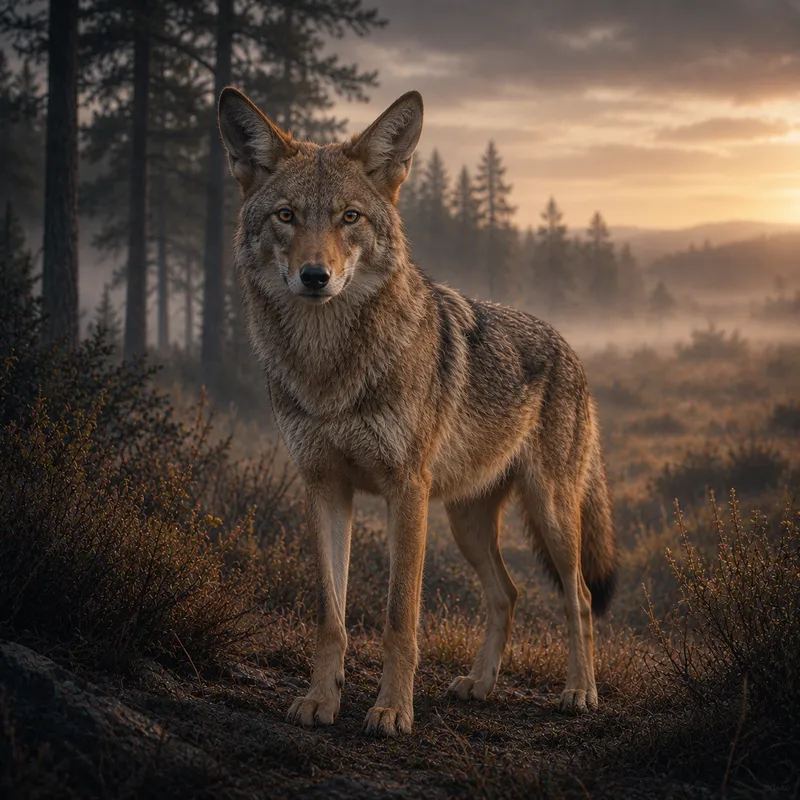
Coyote therians are adaptable, resourceful survivors. Coyotes thrive almost anywhere — from wilderness to cities — and coyote therians often describe that same ability to make a home and find a way through anything.
Coyote therians tend to be clever, flexible, and playful, blending the social and the solitary as needed. There's often a trickster streak and a deep resilience — coyotes adapt where others can't.
The Most Adaptable Canine in North America
The coyote (Canis latrans, roughly "barking dog") is native to North America. Two centuries ago it lived mainly in the prairies and deserts of the west. Since then, as wolves were driven out and forests were cleared, coyotes have spread across almost the entire continent, from Alaska to Central America, and into the hearts of big cities.
That success comes from flexibility in almost everything:
- Diet. Coyotes eat rodents, rabbits, insects, birds, carrion, fruit and berries, adjusting to whatever the season offers.
- Schedule. In wild areas they may be active by day; in towns they often shift to the night to avoid people.
- Social life. Coyotes can live alone, as a mated pair, or in a small family group, depending on food and territory.
- Size. Much smaller and lighter than a gray wolf, closer to a medium-sized dog, with a narrow muzzle and large ears.
Mated pairs often stay together for years and raise their pups as a team, with older offspring sometimes helping out.
The Coyote Chorus
Coyotes are among the most vocal mammals in North America. Their group calls mix howls, yips, barks and wavering wails, and two or three coyotes can sound like a much larger crowd. Researchers think these choruses help family members keep in touch and tell neighbouring groups that a territory is occupied.
Many coyote therians say this is one of the clearest places they feel their theriotype: an urge to yip or howl along with others, or a jolt of recognition when they hear coyotes at night. If you vocalise during mental shifts, a private space or a friendly howl with other therians is a comfortable place to let it out.
What Being a Coyote Therian Can Look Like
Coyote therians often describe themselves less by a single trait and more by a way of handling life. Some patterns that come up:
- Making do. A knack for getting by with what is available, whether that's turning leftovers into a meal or finding an unusual route to a goal.
- Edge-dwelling. Feeling at home in the overlooked parts of a town: old railway lines, scrubby parks, the space between suburbs and fields.
- Flexible social needs. Happy alone for a while, then wanting your one or two closest people, then curious about a group. Not quite a wolf's pack, not quite a fox's solitude.
- Cautious curiosity. Watching new people or places carefully from a distance before getting close.
- Phantom sensations of tall, pointed ears, a narrow muzzle, or a bushy tail held low, which is how coyotes typically carry it while running.
You can read more about the kinds of experiences therians report on our shifts guide.
Coyote, Wolf or Fox?
Coyotes sit between wolves and foxes in many people's minds, so it is very common to question between them.
- Versus the wolf: wolves are much bigger, rely on a stable family pack, and generally avoid human areas. Coyotes are smaller, socially flexible, and thrive right alongside people.
- Versus the fox: foxes are smaller still, usually hunt alone, and have cat-like slit pupils. Coyotes have round pupils, run in pairs or small groups more often, and have a more dog-like build.
- Versus the dog: dogs seek human companionship. Coyotes live near people but keep their distance, which many coyote therians recognise as a "near but not with" feeling.
In parts of eastern North America, coyotes carry some wolf and dog ancestry from past interbreeding, sometimes called "coywolves" or eastern coyotes. Some therians feel connected to this mixed canine heritage in particular.
A Note on Coyote in Stories
Coyote is an important figure in the traditional stories of many Indigenous peoples of North America, often as a trickster, teacher or creator. Those stories and their meanings belong to the cultures that tell them, and they vary a great deal between nations.
A coyote theriotype is about identifying as the real animal, and doesn't require claiming any spiritual or cultural role. If you are curious about Coyote stories, it is respectful to learn from Indigenous storytellers and sources directly, rather than borrowing them as part of your identity. Whether you understand being a therian spiritually, psychologically, or simply don't know yet, all of those framings are welcome here; see our introduction to therianthropy.
🌟 Signs the Coyote Might Be Your Theriotype
- You adapt and thrive in almost any situation
- You're resourceful and resilient under pressure
- You blend social and solitary as it suits you
- You have a clever, playful, trickster streak
- You experience phantom ears or a tail
🌀 Common Shifts
Common shifts include adaptable mental shifts and phantom shifts of tail and ears. Learn more on our shifts guide & quiz.
💚 A Note on Respect
Your theriotype isn't a choice, a phase, or a costume — and only you can truly know it. A quiz like ours can point you toward animals worth reflecting on, but take your time. There's no "fake" therian and no rush. If the Coyote resonates, explore it gently through introspection, dreams, and community.
Coyote Theriotype FAQ
Is a coyote therian just a smaller wolf therian?
No. Coyotes are a separate species with their own behaviour, voice and way of living. Many coyote therians describe a flexibility and comfort living on the edges of human life that feels quite different from a wolf identity.
Does being a coyote therian mean I am a trickster?
Not necessarily. The trickster image comes mostly from stories, not from the biology of real coyotes. Some coyote therians do describe a playful, clever streak, but plenty are serious, quiet or cautious. Your theriotype describes what you are, not a personality you have to perform.
I live in a city. Does that make me feel more coyote?
Possibly, since coyotes are famous for thriving in cities. But where you live does not create a theriotype. Look for feelings and instincts that stay consistent across places and over time.
Can I identify as a coywolf or eastern coyote?
Yes. Eastern coyotes are real animals with mixed coyote, wolf and dog ancestry, and some therians feel this specific animal fits them best. If you feel connected to several canines equally, you might also read about polytherians and cladotherians.